Syrris logo

English | Deutsch (NEU) | 日本語 | Português

SitemapSitemap
VideosVideos
SupportSupport
  • Homepage
  • Company
    • History
    • Testimonials
    • Syrris for Beginners
    • Careers
    • Syrris Customers
    • Awards and Accreditations
  • Batch Products
    • Atlas Overview
    • Atlas Jacketed Reactors
    • Atlas Calorimeter
    • Atlas Pressure Reactors
    • Atlas Flasks and Vials
    • Atlas Parallel Systems
    • Atlas Syringe Pump
    • Atlas Software Overview
    • Batch Reactor Catalogue
    • Globe Chemical Reactor
    • Custom Reactor Overview
    • Reactor Master
    • Bioisostere Software
  • Flow Products
    • Asia Flow Chemistry
    • Asia Manual Systems
    • Asia Automated Systems
    • Asia Process Optimization
    • Asia Modules
    • Asia Catalogue (Parts)
    • Africa Flow Chemistry
    • Africa Modules
    • Africa Accessories
    • FRX Flow Chemistry
  • Applications
    • Flow Chemistry
    • Discovery / Medicinal
    • Reaction Calorimetry
    • Process Chemistry
    • Crystallization
    • Other Applications
  • News
    • News
    • Latest Events
    • E-Newsletters
    • Syrris in Publications
  • Contact Us
    • Syrris Group Offices
    • Local Distributors
    • Who can I talk to?
  • Downloads
Syrris News Articles
Home News News Archived News Sustainable Chemistry with the Flow
  • News
    • Archived News
  • Latest Events
  • E-Newsletters
  • Syrris in Publications

Sustainable Chemistry with the Flow - Syrris

Sustainable Chemistry with the Flow

Flow Chemistry, a new tool for sustainable chemistry

Flow chemistry is one of the biggest innovations of the decade in the chemistry world. Bringing a new approach to how to carry out a chemical reaction, flow chemistry quickly drew attention from academic research and industry. This new tool for chemists presents several advantages for developing sustainable manufacturing routes and many industries, pharmaceutical and nanotechnology in particular, have already heavily invested in this technology.

Glass Microreactor Chip

Glass Microreactor Chip for Asia Flow Chemistry Systems

Compared to traditional batch reactors, microreactors and flow chemistry bring numerous benefits to the chemists who can use them to develop more efficient, continuous processes. A non-exhaustive list of those benefits contains:

  • Faster reactions
  • Safer reactions
  • Fast reaction optimization
  • Some reaction conditions not achievable in batch
  • Usually more selective reactions
  • Easier scale up easier
  • Easier work-up and integration of reaction analysis
  • Easy automation

This article will focus on some of those benefits.


Basics of flow chemistry

In flow chemistry, the reagent solutions are continuously pumped into a microreactor where the reagents mix and react to form the product which then leaves the microreactor as a continuous stream. This concept implies to rethink how we approach the experimental conditions.

Rather than talking about reaction time, flow chemists are talking about residence time (time spent by each fraction of the reagent stream in the microreactor) which is directly controlled by the flow rate of the pumps. Shorter residence time are achieved by pumping faster, and longer residence time by pumping slower.

The quantities made are not a function of how big your reactor volume is but what flow rate is set-up and how long you leave your system running for: running a reaction in flow conditions for several minutes will yield milligrams quantities of a product, leaving the system running overnight will give several grams or more of product. Also the chemist often needs to adapt its chemistry as all reagents and intermediates need to be in solution in order to be pumped without blocking the channels. Any non-soluble reagents must be solid-supported or used pure packed in a column.

A typical flow chemistry system is made of a pump, a microreactor (with a way of heating or cooling it) and a back-pressure regulator. Several modules can be added to this core system in order to extend its functions and versatility: pressurized input for using low boiling point solvents, reagent injection loops for the handling of small volumes of reagent, flow liquid-liquid extraction module for continuous work-up, automated collectors for multi-sample collection, computer software for full automation of a list of experiments, etc…

Glass Microreactor

Fig. 1 - A Glass Microreactor manufactured by Syrris

See Specifications

The key characteristic of flow microreactors is that they have very small channels, typically with an internal diameter <1 mm. Due to the extremely small diameter of microreactor channels, the flow of reagents is under laminar conditions meaning ultra fast and reproducible mixing. Also, due to the large surface to volume ratio of the microreactor, the heating and cooling of the reactor content is accurate, fast and easy. The best microreactors are glass microreactors (see Figure 1) which offer excellent chemical compatibility, wide temperature user range and good resistance to pressure. Glass microreactors are also self-cleaning: after each experiment, the reactor is automatically cleaned by solvent flowing through and the reactor is ready for the next experiment without any need for the user to dismantle their system.

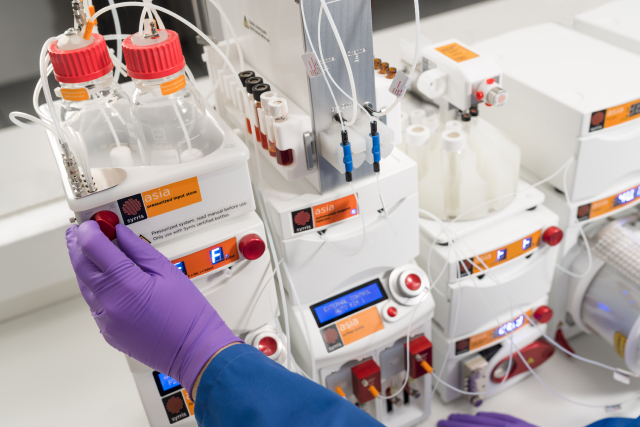
With a small and compact bench flow chemistry system, such as the Syrris Asia system (see Figure 2), a chemist can carry a quick process optimization, scale-up the reaction on the same equipment using the best conditions and then transfer it after some adjustments to a plant with continuous process capability.


Faster reactions and reactions not possible in batch:

Flow chemistry offers different benefits. One of the advantages of flow chemistry is that you can easily pressurize the microreactor using a back-pressure regulator: due to the small volume of the reactor the pressurization is easier to put in place and much safer. Pressurizing the system allows to heat solvent above their boiling point (commonly called ‘super-heating’). This has a similar effect on chemistry as using microwaves (but without the scale limitation): it increases reaction rates and enables reactions previously categorized as impossible.

Super-heating not only reduces reaction time but it also allows the use at high temperature of common low boiling point solvent (water, ethanol, ethyl acetate) instead of high boiling point solvent such as DMF and DMSO which are more difficult to get rid of. All this enables a quicker process with more friendly solvents. Nicholas D. Cosford et al. published several papers describing protocols for the synthesis of a variety of aromatic rings using high-temperature capability which illustrates the advantage of super-heating.


Safer reactions

The excellent heat exchange of the microreactor enables reactions with fast exotherm to be carried out safely, any temperature increase being absorbed very quickly. Furthermore, the small volume of the microreactors (typically <20 mL for the biggest compare to several litres for traditional batch reactors) ensures there is almost no harm for the user in the case when things go wrong.

Reactors can easily be put in series allowing a two (or more) step reaction with no downtime between steps. A flow chemistry system is closed from the reagent input to the collection point with no contact with ambient atmosphere ensuring that all potentially dangerous reagents and intermediates are contained while transiting in the reactor and from one reactor to the next one.

The small reactor volume in flow chemistry also extends the possibilities in terms of process by giving access to less used type of reactions such as photochemistry, electrochemistry or hydrogenation. Those reactions, often disregarded on a large scale due to their dangerousness or impracticality, are easier to put in place and control on a continuous flow system.

Automated Asia Flow Chemistry System

Fig. 2 - Asia 310 Flow Chemistry System from Syrris

Download Catalogue


Cleaner reactions

Glass microreactors enable excellent heat transfer ensuring quick heating or cooling, accurate temperature control and fast elimination of exotherm and endotherm. Combined with efficient, fast and reproducible mixing, this enables very precise reaction control. As a consequence the reactions carried on a flow microreactor are often cleaner, with better yields and less by-products.

Catalytic reactions are cleaner too when carried out in flow chemistry. The catalyst can be solid-supported and packed into a glass column through which the reaction solution is flown. This presents two main advantages:

  • Over-exposing the reagents to the catalyst, meaning faster and better yielding reactions.
  • No need for filtration of the catalysts, therefore reducing man-steps. Any leaching catalyst can be caught downstream using scavengers resins packed in glass column plugged at the end of the fluidic set-up.

Quick reaction optimization

Flow chemistry systems can easily be automated. For example, Syrris Asia flow chemistry modules can be controlled in three different ways: manually controlled from the front panel, automated from the Asia Syringe Pump (the heart of all flow chemistry systems) or automated from a computer. This allows users to set-up a series of experiments, let them run overnight then collect the different samples on the next days, analyze them and identify the best reaction conditions. Having a self-cleaning reactor is a clear advantage as it allows to do numerous small-scale reactions one after the other without having to stop and reset the system in-between.

A step further can be taken by integrating in-line analysis or sample preparation. A module like Syrris Asia Sampler and Dilutor automatically takes samples, dilutes them to a pre-defined factor and inject them into an HPLC, UPLC or any other analytical device. The automation of the full discovery process from reaction to work-up and analysis saves valuable time for the chemist and speeds up the identification of the best reaction procedure.


Easier scale-up

Starting on a small scale for optimization and analysis purposes, a chemist can easily increase the amount of product produced on a flow chemistry system just by letting the system run longer. If larger quantities are needed, the flow user can effortlessly transfer the same experimental conditions (residence time, temperature, back-pressure, concentration of reagents) to a larger reactor therefore increasing the production rate.

All the system benefits previously discussed such as fast and reproducible mixing and good temperature control ensure excellent reproducibility and minimum adjustments to the process for large scale.


Conclusion

Flow chemistry is a new approach to chemistry which offers great benefits for the design of sustainable routes. As with every new tool, it requires learning and practicing and reactions needs to be adapted in order to be performed on a flow system but those efforts are worth it when considering the advantages: improved reaction control, cleaner and safer reactions, no cleaning needed, full automation, easier scale-up etc.

This exciting new method for carrying out reactions will no doubt grow in the next years and more and more continuous processes will appear in a wide range of industries.


Download the Asia Flow Chemistry Catalogue to learn more.


References

1. D Grant, R Dahl, N D P Cosford, J Org Chem, 2008, 73, 7219–7223.

1a. N Pagano, A Herath, N D P Cosford, J Flow Chem, 2011, 1, 28–31.v

1b. A Herath, N D P Cosford, Org Lett, 2010, 12, 5182–5185.

2. R Tinder, R Farr, R Heid, R Zhao, R S Rarig Jr., T Storz, Org Process Res Dev, 2009, 13, 1401–1406.

2a. V Pandarus, G Gingras, F Beland,R Ciriminna, M Pagliaro, Catal Sci Technol, 2011.

For more information, please call +44 (0) 1763 242 555 or contact us